Village, Hamlet or Market Town: What Sets Them Apart?
Village, hamlet or market town: describe rural settlements more clearly by comparing their layout, shared places and local role rather than relying on labels.
The common mistake when deciding whether a place is a village, hamlet or market town is to treat the label as a fixed classification. Local usage varies, and names alone can obscure how a settlement is laid out or what it does for nearby places. To describe a rural settlement clearly, compare its homes, shared facilities and everyday connections, then treat any category as a useful shorthand rather than a verdict.
Imagine you are walking through the invented rural district of Merefield. Its map marks Lower Mere, Wold End and Mereford, but offers no reliable definitions. Lower Mere is a loose group of homes beside a lane; Wold End clusters around a green; Mereford has a busier centre used by people from nearby settlements. These patterns can suggest familiar labels, but local residents might use different terms.
What can the approach road tell you?
Start with the road, but do not let it decide the category. A hamlet-like cluster may sit on a through-route, while a village may be tucked away at the end of a lane. Notice whether the road simply passes the buildings or leads towards a recognisable shared place.
At invented Lower Mere, houses stand in loose groups along the lane, with paddocks and gaps between them. There is no obvious centre, so “small residential cluster” is a careful description. It may be called a hamlet locally, but that label is not a universal rule.
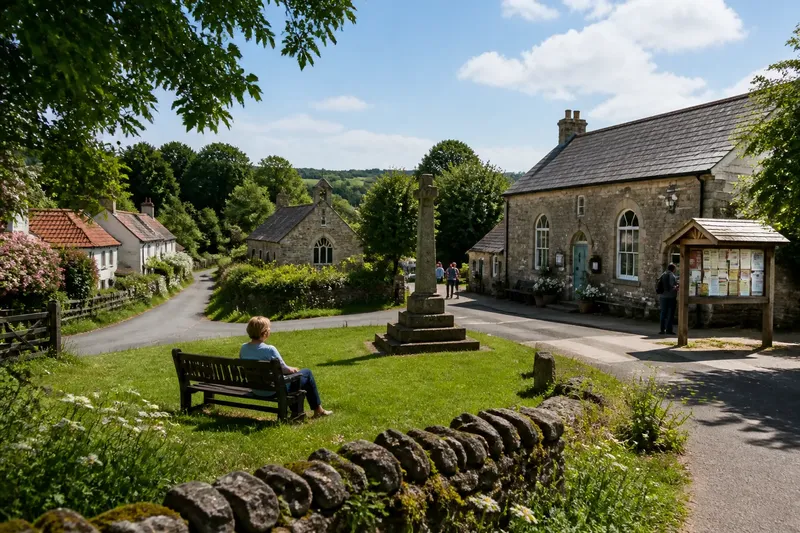
At invented Wold End, several lanes meet near a green. A chapel, noticeboard and small hall provide places to gather. That arrangement may be described as village-like, though neither a green nor a hall is required for every place called a village.
Describe the settlement’s shape before assigning it a name.
How should you recognise a village without relying on one feature?
In everyday use, “village” often suggests a settlement with a shared local focus or community life. The focus might be a green, parish hall, place of worship, sports ground or regular meeting place. No single feature settles the matter: a village can lack a shop, and a small cluster can have a chapel.
At invented Wold End, the hall faces the green, and a footpath connects nearby homes to both. Residents have a clear point of orientation: they can arrange to meet “by the green”. The layout supports a village-like description, but local naming and usage may differ.
Some places have a distinct core with outlying lanes; others stretch along a road. Look for shared places and routines rather than expecting a neat circle of buildings.
What makes a settlement function as a market town?
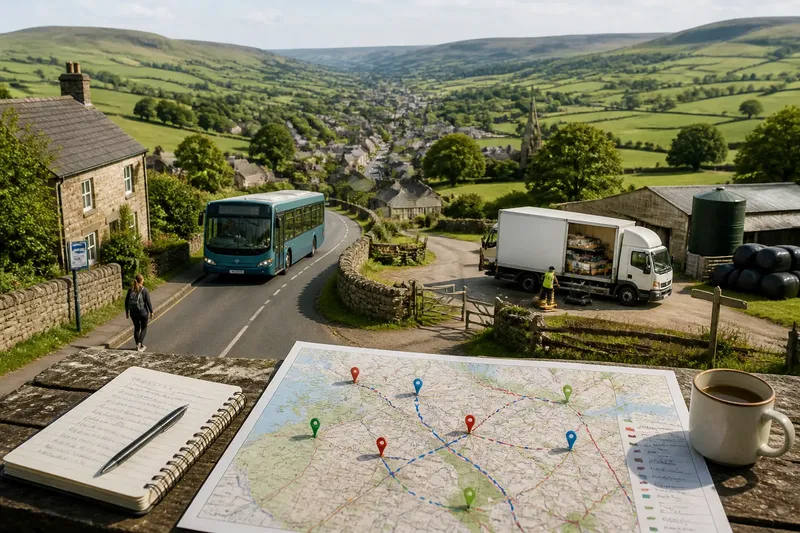
“Market town” often describes a settlement’s wider role in the local network, not simply its size or current activity. People may travel there from surrounding villages and hamlets for shops, services, appointments, trade or transport. A main street, square, library, health centre or bus links can help reveal that role, but no one facility is decisive.
In invented Mereford, a food shop, post counter, library and bus stop sit along the main street, which is also used by people from nearby settlements. A useful description would explain that wider reach. The phrase “market town” need not mean that a market is currently held, and local usage may not match a tidy definition.
Say what the place serves, rather than assuming its label explains everything.
Which clues help when settlement labels overlap?
Use these observations together. For each one, decide what the evidence supports and what alternative wording would remain accurate:
- Building pattern: If homes are scattered or separated by fields, describe a dispersed settlement; if they cluster around a centre, describe that pattern instead.
- Shared places: If a green, hall, chapel or other recognised meeting point is used by residents, mention it; if no shared place is evident, avoid claiming the settlement has a clear community centre.
- Local reach: If facilities draw visitors from several nearby places, describe a wider service role; if they mainly serve local residents, describe the settlement’s local focus instead.
- Street structure: If shops and services gather along a main street, name that centre; if they do not, describe the actual arrangement rather than implying a town centre.
- Connections: If paths, roads or bus routes link surrounding places to the settlement, note those links; if the connections are limited, avoid overstating its regional reach.
- Daily use: If people go there for routine errands, gatherings or services, say what they use it for; if evidence of regular use is unclear, stick to visible facilities and qualify the account.
No single clue settles the category. A village can have no shop, a hamlet can have a chapel, and a market town can feel quiet away from its main street. Let the combined pattern guide your wording, while keeping local usage in view.
How can you describe a place when local labels differ?
Say you are writing a walking note about invented Lower Mere. Your first draft calls it a hamlet because the houses form loose groups without an obvious shared centre. A resident then points out that people meet at a converted barn on the lane. You revise the description to “a small cluster of homes along the lane, with a local meeting place”. That records both the visible pattern and the new detail without insisting on a disputed category.
For invented Wold End, “a settlement gathered around a green, hall and chapel” describes what a visitor can see. For invented Mereford, “a centre used by people from surrounding villages for shops, services and buses” explains its wider role. Add a familiar label only if it helps, and make clear that it reflects local usage or your own shorthand.
A name on a sign and a description in a guide are different kinds of evidence. The sign records a chosen or inherited name; your account describes layout and current use. You can report both without making one cancel the other.
What do readers ask about village, hamlet or market town?
Can a village have no shop?
Yes. A shop is not a universal requirement for a place called a village. Describe any shared centre or community use you can identify, and qualify the label if local usage is uncertain.
Can a hamlet have a church or chapel?
Yes. One notable building does not settle how a place should be classified. Consider the wider pattern of homes, shared places and local activity.
Does a market town need a market?
Not necessarily. “Market town” may describe a centre’s role for surrounding settlements even when no market is currently held. Explain the services or connections that support the description.
Is there an exact population dividing line?
There is no single everyday threshold that reliably separates these terms across all local usage. Scale can help describe a place, but its layout and role offer more context.
What should you carry into the field?
Ask whether buildings form a loose cluster, whether people share a recognisable place, and whether visitors come from elsewhere for services. For village, hamlet or market town, compare those observations with local names and usage rather than treating a category as fixed.
The clearest settlement description joins what you can see to what the place does. Name its physical pattern, identify shared facilities and explain whom they serve. That gives readers a grounded account even when local labels overlap.